Welcome to my home on the web
In these pages are various musings, mostly on physics. I hope that we share a common
interest and you might find something worthwhile here also.
News
MiniBoone Neutrino experiment
suggests fourth flavor of neutrino may exist. Also see
here and
here.
KEKB electron-positron collider finds evidence for a
four-quark meson.
Fermi Lab has
announced the discovery of a new baryon. Because it is made up of a quark
from each of the 3 families of quarks, it is being called the "triple scoop".
What's Up Lately
August 14, 2011
Review of Seirawan's Chess Duels
Amazon is dragging their feet on publishing this. Maybe it's too long, who knows?
So, here it is, with the bonus of javascript chess board to see the variations which
is not possible at Amazon.
January 12, 2011
3D Computer Graphics, Rotations, and lazy Professors
A standard text on computer graphics is "
Introduction to Computer
Graphics" by Foley, Van Dam, Feiner, Hughes, and Phillips. Even though
it was published in 1997, it covers many core techniques that are still useful
for writing graphics
programs today.
No book is perfect, yet Foley's treatment of rotation
matrices leaves something to be desired. Depending on ones interests, this
may not be a major concern. But one can easily find lecture notes (on the
internet) for graduate level computer graphics courses
that repeat Foley's treatment of rotations almost verbatim. And that is just lazy -- at
the graduate level one expects, well, a graduate level presentation... so I am presenting a more mathematically correct treatment of rotation matrices as
they apply to the computer graphics pipeline,
here.
December 19, 2010
The second installment in the Fourier series articles
is avaiable here
. Again, the .Net framework is required.
December 5, 2010
December is the anniversary of one of the great mathematical results of all time -- Fourier's Theorem,
--which was
first announced to the French Academy of Sciences on December 21, 1807 (to an unfortunately lukewarm reception
by the French mathematicians). To celebrate this, I will be publishing some Fourier series articles, starting with
this one.
(This is an Xbap. Xbaps give a little more power than Silverlight, but require
the .Net framework be installed on the client machine.)
October 18, 2010
Benoit B. Mandelbrot (November 20, 1924 – October 14, 2010)
The great Polish/French/American mathematician was probably best known for his
paradigm shifting work with fractals, a term he himself coined. Perhaps one of
his most interesting, and at first blush seemingly preposterous results is that
the coastline of England is not well defined. Depending on the scale one was
using to make measurements, one would get significantly different values for the
length of the coastline. By
extending the definition of a coastline to be a fractal curve, and by
using concepts from measure theory, notably the work of Hausdorff, Mandelbrot put
the concept of coastline length on a firm mathematical footing.
October 16, 2010
Elton John and Подмосковные Вечера
As Elton John is currently touring the US,
some Russian-Elton trivia rather than the usual Math/Physics/Computers might be of interest...
October 10, 2010
AS an undergraduate mathematics student, I had a
topology professor who would tell his students about the early days of topology.
There was it seemed a Polish cafe where the Polish mathematicians would
congregate and discuss mathematics for hours on end. And when some mathematician
stumbled upon a problem or conjecture that was interesting but he could not
solve, he could ask the coffee house staff for a book that was kept there just
for the mathematicians...and in which the problem would be recorded as a challenge
for any mathematician who visited the coffee house. From this cafe sprung many of the early results of topology and measure theory,and the book
became rather famous, at least among topolgists...
It's a rather romantic story, but one that students tend to put aside as they concentrate on the job of actually learning the subject of topology.
...Fast forward about 80 years -- that cafe is now a bank...that part
of Poland is now Ukraine, and
the Polish city of Lwow where the coffee house was located is now the Ukrainian city of Lviv (from the Russian/Ukrainian
for Lion...and if you visit Lviv you will discover many wonderful statues and
sculptures, some quite old, of lions.)
Having visited Lviv a few times I have tended to concentrate on exploring the usual
tourist attractions...but on my most recent visit,
I had to see if I could find this Scottish Cafe....
February 9, 2010
It appears the Ukrainian Orange Revolution has suffered a setback in the
recent Ukrainian elections. In 2005, pro-Russi
San Yanukovich suffered a defeat
when the
Ukrainian Orange Revolution protests against his falsified election propelled
pro-western Viktor Yuschenko into power. Now it seems Yanukovich has made a suprising comeback,
barely defeating Yulia Tymoshenko. Good videos of the Orange Revolution are not so easy to
find, I have therefore made a few from my collection available here.
December 10, 2009
Passed Microsoft Exam 70-562,.NET Framework 3.5 ASP.NET
Application Development
November 25, 2009
I have been somewhat busy lately and have not had the time
to give the Contravariance and Covariance articles the polishing and filling out
they deserve.
Unfortunately, today I viewed some painful content on
the web purporting to discuss
the connection between contravariance and covariance
in physics and computer science...so some further remarks perhaps may be in
order:
The idea of contravariance and covariance in physics and math is usually
a statement about how something (for example, a vector) transforms with respect
to a specified group of transformations (i.e., the group of rotations, for example).
Category theory abstracts and generalizes the concept, and this allows it to be
applied to computer language design, for the simple reason that computer language
design is often expressed in algebraic (and hence categorical) terms.
The distinction between contravariance and covariance may even
appear in a rectangular coordinate system (I alluded to this in part 1),
though it is easy to find texts that mistakenly state otherwise. Therefore, no differential
geometry, curved spaces, or even calculus, is required. You do however have to know
how to do a coordinate transformation. This is why I started my discussion with
oblique coordinates and the reciprocal lattice in part 1.
The idea of contravariance and covariance is more an algebraic
concept than a geometric one, and it expresses the relation between vectors, dual
vectors, and the invariance of scalars under a transformation. I could have easily
omitted parts 3 and 4 on tensor analysis and manifolds, and went straight to category
theory, since the relevant definitions in 3 and 4 are motivated by and may be thought
of as an extension of the algebraic concepts found in parts 1 and 2.
(By the way, if it is not clear that contravariance and covariance
can appear even in rectangular coordinates, take a look at section 1.3 of "Methods
of Theoretical Physics", part 1 by Morse and Feshbach, and in particular, pages
30-31 on contravariant and covariant vectors, where they show it is sufficient to
merely introduce a scale factor in the new coordinate system.)
November 13, 2009
Passed (first attempt) the Microsoft .NET Framework
3.5
WCF 70-503 certification test.
October 12, 2009
Contravariance and Covariance, part 5, available
here.
October 5, 2009
Contravariance and Covariance, part 4, available
here.
September 28, 2009
Contravariance and Covariance, part 3, available
here.
September 22, 2009
Contravariance and Covariance, part 2, available
here.
September 16, 2009
Contravariance and Covariance, part 1, available
here.
September 10, 2009
Glashow, Feynman and good men...
Besides being a brilliant physicist, Sheldon
Glashow has the added distinction of leaving Harvard for Boston University, because,
it is rumored, of Harvard's insistence on string theory.
Nova and also his book "Interactions" give his criticisms of the "theory".
Interactions also gives Glashow's observation of a good chemist, which is very interesting:
"Chemists can entirely neglect the effects of the strong, weak, and gravitational
forces. They have no need to know about the inner structure of the atomic nucleus
or understand Einstein's theory of gravity. (Of course, good chemists often
do know these things, just as they speak French, read Milton, and play the oboe.
But it's not all that important to their professional activities.)"
-- Sheldon Glashow
Feynman, perhaps not surprisingly has a different view on, not
what makes a good chemist, but a good professional man, in general:
Video: Feynman
The contents of the page
could not be displayed.
This can be caused by the following reasons:
- Microsoft Internet Explorer blocks the flash content on your page.
Click the warning in the upper part of the browser and select the Allow Blocked
Content... option to continue opening the page.

- You need to install or upgrade your Flash Player.
Please visit the
Adobe site to download and install the latest version of the Flash Player
necessary to be able to display the contents of this page
While it may not be
easy to do so, one can at least
try to emulate Feynman's description.
One thing I have noticed in looking at Microsoft's implementation
of contravariance and covariance is that the people who write about it do not seem
to have complete knowledge of the concept. To hopefully assist in remedying that
situation, I will be writing a series of short articles on the concept of contravariance
and covariance as it is understood in mathematics and physics, and touch on the
origin of its use in programming languages.
August 5, 2009
Feynman, Putin, and Microsoft...
Vladimir Putin was
recently
shown on Russian television cavorting around Kyzyl, Tuva. (The
same Tuva after which Microsoft named its excellent
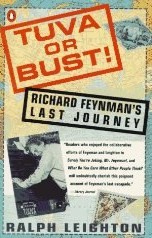
Tuva Project). Tuva was made famous in the physics world in 1991 by the
publication of "Tuva or Bust, Richard Feynman's
Last Journey"... All this recent
Tuva media attention caused me to dust off and re-read that book...leading, interestingly
enough, to the discovery of a previously unknown, but unfortunately somewhat widely
propagated,
Feynman error.
July 27, 2009
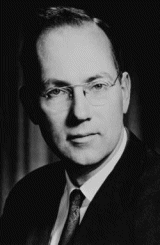
Charles Townes
(b. 7/28/1915), inventor of the maser/laser, celebrates a birthday this week.
July 25, 2009
Bill Gates has done a very great thing for physics education
by purchasing the rights to the Feynman Messenger Series lectures and made them
freely available online at the
Tuva Project. Thank you, Mr. Gates!
May 31, 2009
The superior accomplishment of Jewish physicists
has always presented a puzzle.
Feynman touched on an explanation in his "Is Electricity Fire" Feynman story:
"One of the questions the rabbinical students and I discussed
at some length was why it is that in academic things, such as theoretical physics,
there is a higher proportion of Jewish kids than their proportion in the general
population. The rabbinical students thought the reason was that the Jews have a
history of respecting learning: They respect their rabbis, who are really teachers,
and they respect education. The Jews pass on this tradition in their families all
the time, so that if a boy is a good student, it's as good as, if not better than,
being a good football player."
Eugene Wigner attributed the success of Jewish immigrants in physics to hard work:
"Many people have asked me: 'Why was this generation of Jewish
Hungarians so brilliant?' Let me begin by making clear it was not a matter of genetic
superiority. Let us leave such ideas to Adolf Hitler. How could anyone feel 'genetically
superior' to Enrico Fermi or Werner Heisenberg? Much of the credit belongs to the
superb high schools in Budapest, which gave us a wonderful start. But a greater
spur to our success was probably the fact of our forced emigration. Emigration can
certainly be painful, but a young man with talent finds it stimulating. Outside
your own nation, you lack a ready place. You need great ingenuity and effort just
to find a niche. Hard work and ingenuity become a habit. Often they are enough to
earn you a place above natives of your adoptive country quite as talented as you."
Now cognitive psychologist Richard E. Nisbett's new book
"Intelligence and How to Get It -
Why Schools and Cultures Count" has
presented a compelling argument that the IQ differences between races are entirely
environmental in origin.
In particular, he has chapters on both the Jewish and Asian
cultures (Jews and Asians score the highest on IQ tests) For those interested in
education, and also for parents who desire to provide their children with the best
educational opportunities, I would think this is a must read book. (Incidentally,
Nisbett analyzes the alternate view -- that the difference is purely genetic – and
in particular critiques the arguments made in the “The Bell Curve”)
March 1, 2009
If you value your freedom of speech, you should be aware
of the attempt in the United Nations to seriously restrict it:
http://www.youtube.com/watch?v=Ji-qdC5zYd4
The UN resolution passed last year as a non-binding resolution
and now they want to make it binding...As mentioned in the video, this resolution
has nothing to do with promoting tolerance, but actually the exact opposite -- if
that actually needed to be pointed out.
Any religion(s) that attempts to take away my freedom of speech
richly deserves to be criticized.
January 20, 2009
PBS has announced a new
film on the great J. Robert Oppenheimer to be aired January 26, 2009.
It will be extremely difficult for the PBS to surpass the excellence
of the BBC version "Oppenheimer, the Father of the Atomic Bomb", starring Sam Waterston.
The BBC version is spellbinding drama that is also accurate historically. And, all
the actors actually physically resemble the people they portray.
Even Edward Teller, in
the forward to "Now It Can Be Told", by General Leslie Groves (Groves was the general
in charge of the Manhattan Project), expressed his opinion that the seven-hour BBC
production was the best of the television dramas on Oppenheimer and Los Alamos.
What the PBS can pack into a mere 2 hours we will have to wait and see.
Incidentally, the DVD version of the BBC film has an amazing
26 minute interview of Opie at the Institute for Advanced Study at Princeton, NJ,
where he was the director. The famous Oppenheimer charm and intelligence is obvious.
October 28, 2008
Sarah Palin attacks fruit fly research:
Sarah Palin's War on Science
http://www.youtube.com/watch?v=HCXqKEs68Xk
Palin's motivation for this attack may have been benevolent, since
she perceived a waste of tax payer monies, but she has unfortunately only
revealed her lack of knowledge of the importance of fruit fly research.
Bertand Russell once defined his concept of the good life as one that was inspired
by love and guided by knowledge:
"Knowledge and love are both indefinitely extensible; therefore, however good a life may be, a better life can be imagined. Neither love without
knowledge or knowledge without love can produce a good life. In the Middle Ages,
when pestilence appeared in a country, holy men advised the population to assemble
in churches and pray for deliverance; the result was the infection spread with extraordinary
rapidity among the crowded masses of the supplicants. This was an example of love
without knowledge." --- Bertrand Russell, 'What I Believe"
Palin does not understand foreign policy and events. She does not seem to understand
science. Russell's observation would seem to be appropriate here.
October 8, 2008
Bell Labs' parent company
has shut down fundamental physics research:
The Bell Tolls For Bell Labs
Bell Labs Kills
Fundamental Physics Research
In the long run, it is obvious this can only have a negative effect
on Bell Labs' ability to innovate and compete, and ultimately, on Bell Labs' bottom
line. Historically, innovation has flourished in the fertile environment that is
provided by basic research. Research into ideas that do not immediately have any
obvious applications often unexpectedly yield tremendous applications.
For example, the second link above mentions the GPS system, which
relies on the hydrogen maser which in turn was dependent upon basic research into
optical pumping. Interestingly, the author failed to mention that GPS critically
relies on Einstein's theory of general relativity, which perhaps
is the ultimate example of pure research without regard to any possible applications.
GPS is comprised of 24 satellites orbiting the earth, all of
which must have synchronized atomic clocks. Determining
your position on the
earth requires the use of 4 of the satellites-- 3 for your longitude, latitude,
and altitude, and the fourth to verify the accuracy of the clock in your GPS unit.
Since clocks run at different rates depending on the strength of the gravitational
field they are in -- and since gravity varies with satellite height -- general relativity
must be used.
But wait; there is even more fundamental research
present in the GPS system. The whole idea of stimulated emission, on which masers
and lasers depend, was discovered by Einstein in 1916. The 1916 paper, "Emission
and Absorption of Radiation in Quantum Theory" (Zur Quantentheorie der Strahlung),
like all of Einstein's research, was basic research.
Here is an example of pure research
having great applications in chemistry and medicine...
The Bell Labs decision is obviously bad, and whoever is responsible
for it should be fired.
September 25, 2008
The large hadron collider (LHC)
experiment in Geneva has been
postponed.
The worries of some that the LHC will generate a doomsday black hole that will swallow
the earth are groundless. The doomsday black hole calculations are based on the
purely theoretical and speculative assumption of extra large dimensions.
This is not the first physics experiment that has been accorded
the possibility of destroying the earth. At Los Alamos, the possibility had occurred
to Teller that exploding an atomic bomb could
in fact produce enough heat to ignite the earth's atmosphere in a thermonuclear
reaction. Therefore, prior to the first atomic test in 1945, Teller, Marvin, and
Konopinski analyzed this possibility in a classified
Report LA-602 for Los Alamos. Of course, they concluded that the bomb would
not ignite the atmosphere, although on first blush the idea is plausible. Even after
the Teller, Marvin, and Konopinski report became declassified in 1973, people were
still claiming this as a possibility -- most famously H.C. Dudley in the November
1975 issue of the Bulletin of Atomic Scientists.
The main candidate reactions for igniting the atmosphere involves
nitrogen:
N14+
N14 --> Mg28 + He4 + 17.7 MeV
or
N14+
N14 --> O16 + C12 + 10.6 MeV
So can either reaction be made to happen? Well, theoretically,
yes.
In the first reaction, the Coulomb energy that is required to bring the nitrogen nuclei close enough for the strong force to kick in is less
than energy released. It is energetically favorable and could, theoretically, be
self sustaining.
In the second reaction, the nitrogens do not even have to be
brought together, only a deuteron need be transferred from one nitrogen to the other.
This is also energetically favorable.
However, the reason the earth's atmosphere does not ignite
in an atomic blast is because there are a couple of non-obvious mechanisms present
that drain energy. For example, part of the energy is lost to the electrons in "braking
radiation" (bremsstrahlung),
which means it gets converted to light and cannot be used to sustain the reaction.
Other atomic processes, such as the inverse Compton effect, also drain energy.
It is interesting to contrast Report LA-602's scientific analysis,
which is based on established scientific theories, and the doomsday black hole calculations,
which are not based on anything but conjecture and speculative theories.
(For a more complete analysis, including the possiblity of igniting
the hydrogen in the world's oceans, see "Ultimate Catastrophe?" in The Road
from Los Alamos by Hans Bethe, pg
30-33)
September 11, 2008
When the first president of Israel, Chaim Weizmann
died in 1952, the presidency was offered to
Albert Einstein. He declined, citing both a lack of experience
and ability...
...and now, the Sarah Palin interview:
http://www.youtube.com/watch?v=WaMJ-xTcGxI
http://abcnews.go.com/Politics/Vote2008/Story?id=5782924&page=1
Gibson was clearly antagonistic --
Palin gets credit for demonstrating poise under fire. Unfortunately, she also exhibited
a dismal knowledge of current events and foreign policy.
So, when Palin claims Russia invaded Georgia "unprovoked" (she
said this twice in fact, after Gibson asked for clarification), she is showing she
is simply unaware that it was Georgia who first sent troops into South Ossetia,
and the Russian invasion was the response. Bush's real time assessment of the situation
was quite accurate, when he said that Russia's response was
disproportionate, meaning that Russia had indeed been provoked,
only that the extent of the Russian response was excessive.
Regarding foreign policy -- a candidate for VP of the United
States should know what the Bush Doctrine is -- that she does not indicates that
she was insufficiently vetted by McCain. Palin's claim that she has both the experience
and ability to be president, in retrospect, seems ridiculous.
September 4, 2008
Sarah Palin in her native state:
http://www.youtube.com/watch?v=QG1vPYbRB7k
Someone has suggested that if you close your eyes and just listen
to the speech, she sounds like a 16 year old school girl. That is overly harsh.
In fact, I would claim that most 16 year old school girls do not sound like religious
zealots.
August 3, 2008
Alexander Solzhenitsyn (December 11, 1918 - August 3, 2008)
Solzhenitsyn studied mathematics and physics at
Rostov, but his experience at the hands of the Stalinist regime caused him
to become a strong critic of the Soviet era. His "The Gulag Archipelago" is perhaps
his most famous work.
The premier Russian television station, Channel 1,
opened its morning broadcast Monday morning with the Solzhenitsyn story and in fact
gave rather extended coverage. Channel 1 showed Solzhenitsyn interviews,
books, public appearances, and even meetings of Solzhenitsyn with Putin and the
Pope...Not too bad for a man who was once stripped of his citizenship and then forced
to leave his country. Russian president Medvedev (the name "Medvedev", if you must
know, translates to English as "Bear") expressed his condolences.
Only Putin's interrupting of live broadcasts of Russian
television in April 2007 to announce the death of the great Russian Cellist, Mstislav
Rostropovich, who incidentally was also exiled from Russia, partly because of his
support for Solzhenitsyn, compares with this reclamation of Solzhenitsyn.
Here is a
Russia Today video about Solzhenitsyn.
July 17, 2008
Fans of Richard Dawkins and Steven Weinberg will find
a new interview here, in
which Dawkins interviews Weinberg.
June 3, 2008
At the University of Waterloo
Bjarne Stroustrup discusses the new language features in C++0x and the reasons
for their adoption. He also touches on garbage collection (and the associated performance
hit), generic programming, and multi-core programming. He mentions that he is writing
a new book on programming with C++ for beginners as a result of his having to teach
freshman Texas A&M University students, which was a new experience for him.
"Programming:
Principles and Practice Using C++" by Bjarne Stroustrup is now
available for pre-order on Amazon.
May 26, 2008
Here in a recent interview, Donald Knuth expresses his views on open source,
unit testing, literate programming, extreme programming, code reuse, and multicore
programming. Knuth's objection to multicore programming was surprising,
as it has already been addressed by Intel with the release of its TBB library --
it is too bad the interviewer did not ask him about TBB. Knuth's main complaint
was that the multicore code would have to be changed substantially every few years
due to the inevitable hardware changes. IF the programmer is using TBB, that is
not the case. (TBB is not a panacea, however, because the fastest
multicore programs will be always be coded with raw threads and not TBB, and in
that case you do have to consider the hardware and Knuth's observation would apply.)
His other objection was that the majority of programs he writes would not benefit
(presumably, because they were not easily parallelizable, or the gain would be minimal
due to Amdahl's law) This
"nobody needs more than 1 core" sentiment is strangely reminiscent of Bill Gates
"nobody will ever need more than 640K RAM" statement.
May 21, 2008
The great Hungarian-American physicist Eugene Wigner
attributed the brilliance of his generation of Jewish Hungarian physicists (i.e.,
he had in mind Szilard, Teller, von Neumann
and himself, a.k.a. "The Martians" as they were sometimes called during the Manhattan
project) partly to the superior Budapest schools ...
Here Steve Ballmer gets to experience the Budapest schools first hand:
http://www.youtube.com/watch?v=S30WdoEHCH4
http://www.youtube.com/watch?v=npYsmDQs4C0&NR=1
February 27, 2008
Bobby Fischer -- (March 9, 1943 – January 17, 2008)
It is perhaps a little too easy to find controversial items on the web about the
late, great former world chess champion Bobby Fischer, but
here and here
are pages showcasing Bobby in a favorable light.
"On the chessboard lies and hypocrisy do not survive long. The creative combination
lays bare the presumption of a lie; the merciless fact, culminating in a checkmate,
contradicts the hypocrite." - Emanuel Lasker
The above Lasker quote (Lasker was not only a great world chess champion and mathematician,
but was also a good friend of Einstein) Fischer selected for the introduction to
his classic "My 60 Memorable Games". While Fischer had always been popular in Russia
and the FSU, somehow the Lasker quote did not survive the Russian translation of
his book.
January 9, 2008
Mr. Wizard -- (July 10, 1917 -- June 12, 2007)
In a classic
episode, Mr. Wizard explains heat transfer.
December 11,2007
http://www.youtube.com/watch?v=nTbeHTgr_TQ
Steven Weinberg -- 1979 Nobel Prize Physics
Nobelprize.org launches TheNobelPrize channel on YouTube:
http://nobelprize.org/nobelweb/pressroom/youtube.html
December 3, 2007
http://www.youtube.com/watch?v=U3tgY_eI_P0
http://www.youtube.com/watch?v=q6Wrhivp7eQ
One man with courage makes a majority. -- Andrew
Jackson
November 29, 2007
http://www.youtube.com/watch?v=5-fjtSxOUes
No god and no religion can survive ridicule. No church, no nobility,
no royalty or other fraud, can face ridicule in a fair field and live.
-- Mark Twain
October 4, 2007
The October issue of Physics Today contains an insightful
discussion of "quantum factoring facts" by N. David Mermin. In it, he explains the
probabilistic method by which Shor's "factoring" algorithm actually works. Anytime
one can find a discussion of quantum computing by a physicist of Mermin's quality,
then there is a fair chance it will contain something of interest. (As a reminder of the relevance of quantum factoring, remember the security of the widely used
RSA cryptosystem is thought to depend on the difficulty of factoring large numbers...quantum
factoring would effectively render RSA broken)
Before retiring, Mermin taught quantum computation at
Cornell to computer science students. Note the class was not taught by a
faculty member of the CS
department. His book is available free
here. The book could be a lot better in terms of explaining the physics
and mathematics of QM, but his goal seems to be just to give the CS student the
minimum material needed to dive into quantum computation. Particulary interesting
in chapter 2, is the following quote:
But a major part of the miracle is only apparent. I did not say that the result
of the calculation is 2n evaluations of f, though many practitioners of quantum
computation are rather careless about making such a claim. All I said (and all one
can say) is that those explicit evaluations occur in the form of the state that
describes the output of the computation. Before drawing extravagant practical or
only, as many practitioners of quantum computation are wont to do, metaphysical
conclusions from quantum parallelism, it is important to remember that when you
have a collection of Qbits in a definite but unknown state, there is in general
no way to nd out what that state is. If there were a way to learn the state of such
a set of Qbits, then I myself would join in the rhapsodic chorus. (Typical verses:
"Where were all those calculations done? In parallel universes!" "The possibility
of quantum computation has established the existence of the multiverse." "Quantum
computation achieves its power by dividing the computational task among huge numbers
of parallel worlds.") But there is no way to learn the state. The only way to extract
information from Qbits is to subject them to a measurement.
Mermin does not parrot the erroneous interpretations that
can readily be found in many quantum computation books, and this is refreshing indeed.
August 18, 2007
Quantum algorithms and computation, by using the properties
of quantum states, have achieved some impressive theoretical results. Grover's search
algorithm, for example, is order N1/2as opposed to the classical result
of order N. So, if you had a list 10000 items to search, classically (by classically,
I mean using a digital computer which implemented its logic using classical digital
circuits and gates), it would take you, on average, N/2 steps, or in our case 5000,
to find the item you were searching for... With the Grover search algorithm, you
would need only 100 steps. Yes. Only 100.
To achieve a basic understanding of how quantum algorithms work,
it is not necessary that you understand all of quantum mechanics but only a very
small subset of QM. You need to understand qubits. Qubits are the quantum mechanical
version of the classical bit, and you would need to know how they combine, evolve
and are measured quantum mechanically. This basic understanding often requires no
more than simple linear algebra (or multi-linear for multi-particle systems). With
this small subset of quantum mechanical knowledge, you can "turn the crank".
Every book on quantum computing I have encountered attempts
to explain the physics behind the crank. However, for whatever reason (I cannot
just believe it is because it is computer scientists that are writing about physics,
because many of these books have physicist co-authors who should know better), every
one of these books have been wrong when it comes to explaining photon interference.
Photon interference is used to illustrate how interference in quantum mechanics
differs from the classical case. Unfortunately, most incorrectly state that a photon
can interfere with itself, and one book gets even weirder by saying that it is the
photon paths that interfere. Evidently, none of the physicist authors were aware
of Roy Glauber's (the 2005 Nobel laureate in physics for his work in quantum optics)
January 1995 letter to the editor in the American Journal of Physics which clarified
photon interference once and for all. I now partly quote from Glauber's letter:
Glauber first identifies the source of the confusion, the great Dirac:
"The source of trouble is a statement by Dirac...'Each photon interferes only with
itself. Interference between two different photons can never occur.'"
And Glauber ends by summarizing what really happens:
"The things that interfere in quantum mechanics are not particles. They are probability
amplitudes for certain events. It is the fact that probability amplitudes add up
like complex numbers that is responsible for all quantum mechanical interferences.
When the event in question represents the detection of a single photon, one can
easily slide into the statement that the photon is interfering with itself. When
one deals, on the other hand, with two-photon states, one still encounters many
species of interference effects, but it would generate intolerable confusion to
interpret these photons as interfering with one another. It is not difficult, for
example, by means of non-linear optics, to construct situations in which interference
takes place between an amplitude for a single blue photon and an amplitude for another
state with two red photons. Quantum mechanics allows such interferences and a great
many other varieties as
well, but no one could sensibly speak of photons as interfering
with themselves or any others in that sort of context.
To sum it all up, these three papers are out in left field.
It is time to put the famous dictum to rest, to remember Dirac and to honor him
for his wonderful contribution to physics, and to forgive him for writing down in
the early days of quantum mechanics a highly simplistic remark which has sowed confusion
among physicists ever since"
Enough said. Photons do not interfere with themselves, no matter how many quantum
computing books claim otherwise.
August 11,2007
As always, you must be careful believing what you read on the
web, and science journalism is no exception to this rule.
Here , for example, is a recent article in Scientific American that makes
the false statement that a quantum compupter "allow hackers to crack today's toughest
coded messages". As there are cryptosystems that are known to be completely secure,
although they are not typically used, we see that the author has either been mislead
by the researchers or he is trying to make the result more sensational than it is.
The most disappointing thing is that the article appeared in Scientific American,
which I had considered held itself to a high scientific standard.